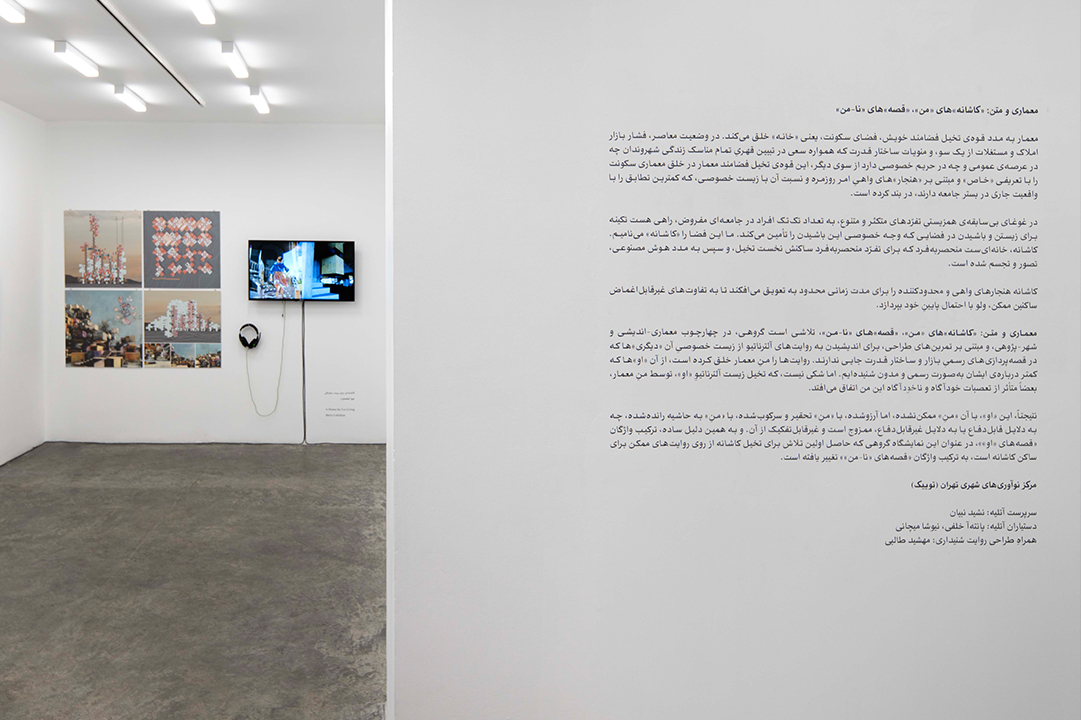
Press Release
The architect uses their faculty of spatial imagination to conjure the space of domesticity—what we call “home.” In its contemporary condition, this spatial imagination is constrained by the relentless pressures of the real estate market, and by the persistent will of the political structure to regulate—often coercively—every ritual of citizens’ lives, both within the public realm and the private domain. As such, the architect’s practice of conceiving domestic architecture is informed by a “particular” definition of domesticity that is framed by fabricated “norms” of the everyday practice of life that bears little resemblance to the lived realities of the society.
In contrast to this flattened unreal image of the domestic realm, with the unprecedented multiplications of divergent modes of individuality, each person in any given society, embodies a singular and uniquely personal approach to inhabiting a space that safeguards one’s private existence. We call this space the “home”. A home is a unique house, made singular for the singularity of its inhabitant; first imagined, and then—through the aid of artificial intelligence—visualized and spatialized.
The home temporary suspends, the limiting and illusory preconceptions of norms of domesticity, in order to engage with the irreducible differences of its possible, if improbable, occupants.
Architecture and Text: “Homes” by the “I”, “Stories” of the “Non-I” is a collective endeavor at the intersection of architectural thinking and urban research, grounded in design exercises that speculate on alternative narratives of private life—those of “the others” who remain absent from the official storylines of the market and of the political apparatus. These narratives are authored by the architect, but they belong to those “others” whose stories are rarely heard in formalized discourse. Inevitably, the imagining of an alternative domestic life for “the other” by the architect is mediated by the conscious and unconscious biases of the architect.
Thus, the “other” is never wholly possible without the “I” —yet also never identical to it. It is a fusion; the wished-for “l” with the repressed and silenced “I”, the “l” that has been marginalized—whether for defensible or indefensible reasons. For this reason, the phrase “Stories of the “Other”” in the title of this collective exhibition—born from our first attempt to imagine a home from the possible narratives of its imagined inhabitant—has been reframed as “Stories of the “Non-l””.
Tehran Urban Innovation Center (TUIC)
In charge of the studio: Nashid Nabian
Studio Assistants: Pante-A Khalafi, Niousha Michani
Collaborating on Narrative Sound Design: Mahsheed Talebi
Projects & Authors:
A Made-to-Order Home, Parisa Khaksar Khomeiran
A Home for the Dual Gaze: Seeing and Being Seen, Mohammad Shahablavasani
A Home for Non-Belonging, Negin Sadri
A Home for the Contemporary Nomad, Nilofar Mahmoudi Majdabadi
A Home for Being “Only” a Woman, Samineh Kolahdoozan
A Home for a Brutalist Minimalist, Shaqayeq Baqerzadeh
A Home for Co-Living, Shiva Lotfalian
A Home for Avoidant Living, Setareh Tehrani
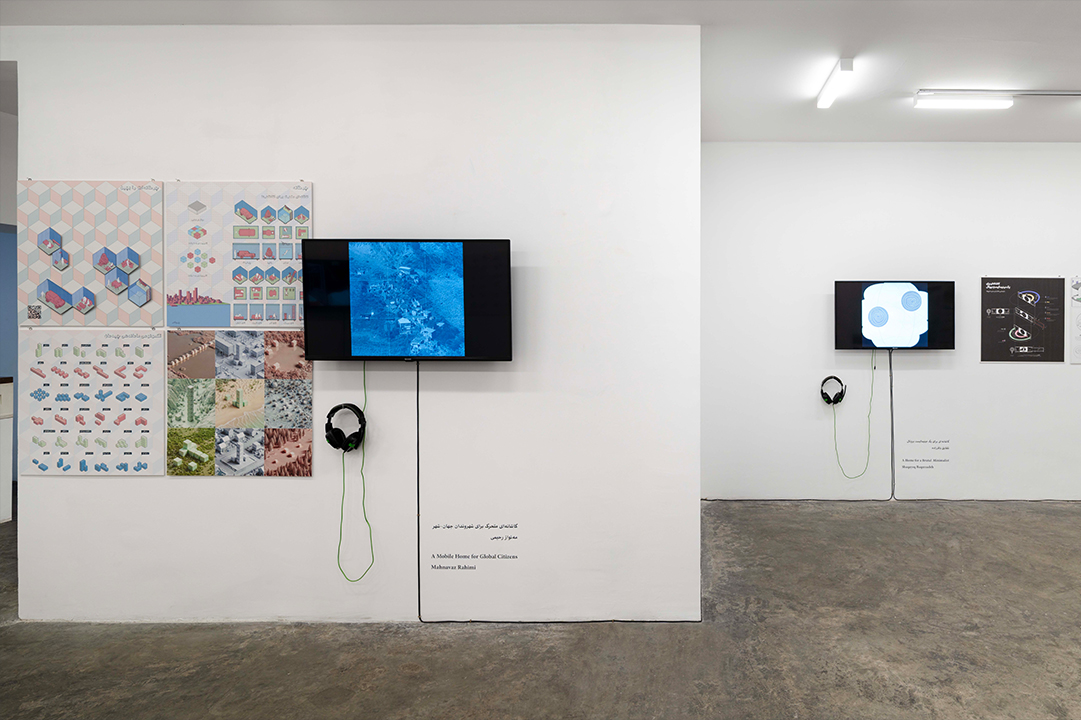
A Mobile Home for Global Citizens, Mahnavaz Rahimi
Installation Views